
TRANSMISSION FAMILY • GM HYDRA-MATIC
GM 4T60-E
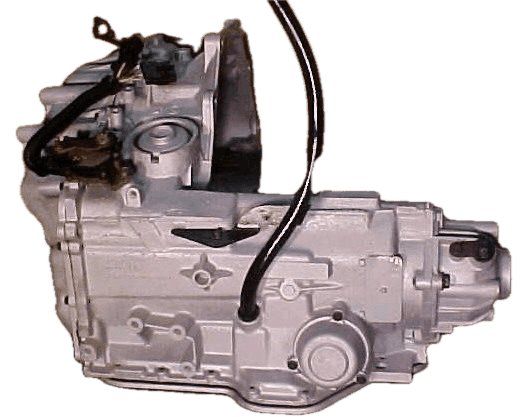
The 4T60-E is GM’s electronically controlled evolution of the 4T60 transverse four-speed automatic. It became a major W-Body transmission during the 1990s, pairing with engines such as the 3.1L 60-degree V6, 3.4L LQ1 Twin Dual Cam and 3.8L Buick V6 before the 4T65-E family took over.
Electronic Controls
Transverse FWD
1990s W-Body
AT A GLANCE
What Defines the 4T60-E?
The 4T60-E kept the basic four-speed transverse architecture of the 4T60 but moved shift scheduling and converter-clutch operation under electronic control. It was produced in numerous final-drive, sprocket, converter and case configurations, making identification critical.
IDENTIFICATION
Identify the Exact 4T60-E Before Ordering Parts
This is the most important part of the page. A transmission being called “4T60-E” does not tell you its final drive, chain ratio, converter, side-cover configuration or model-year revisions.
1. Find the RPO / SPID Label
The Service Parts Identification label is the first place to verify the original drivetrain configuration. Record the engine RPO and all transmission/final-drive codes before removing the original unit.
If the label is missing, use the VIN and transmission identification tag together rather than guessing from year and model alone.
2. Read the Transmission Model Code
GM’s transmission ID charts use codes such as 6PBW, 6HBW, 7AFW, 7HBW and related identifiers. The leading digit corresponds to the model year in the chart, while the remaining characters identify the transmission build/application.
The model code is more useful for interchange than “4T60-E from a W-Body.”
3. Match the Engine and Body
A 3.1L W-Body transmission and a 3.4L LQ1 W-Body transmission can use different final-drive and sprocket combinations. The same is true for 3800 applications.
For example, published 1996 charts show a 3.4L W-Body 6PBW and a different 3800 W-Body 6HBW configuration.
4. Verify Side-Cover Configuration
Identification charts distinguish some applications by 4-bolt versus 6-bolt side cover. This is another reason not to assume two visually similar units are direct replacements.
Side-cover design should be checked along with model code and year.
5. Verify Differential and Sprockets
The differential ratio and chain sprocket ratio work together to determine the effective overall ratio. A 35/35 chain is 1:1, while 33/37 or 37/33 combinations change the effective ratio.
The PCM calibration and vehicle speed information need to match the installed gearing.
6. Watch the Fine-Pitch Final Drives
Later 4T60-E documentation identifies 2.86, 3.05 and 3.29 fine-pitch final-drive sets. Their sun gears, internal ring gears and pinions are not interchangeable with the older regular-pitch components.
Do not mix final-drive parts simply because the numerical ratio looks close.
GEAR RATIOS & FINAL DRIVE
4T60-E Internal Gear Ratios
The internal forward ratios are fixed, while differential and chain-sprocket combinations determine the final gearing delivered to the wheels.
| Range | Ratio | Function |
|---|---|---|
| 1st | 2.921:1 | Launch / maximum multiplication |
| 2nd | 1.568:1 | Intermediate acceleration |
| 3rd | 1.000:1 | Direct drive |
| 4th | 0.705:1 | Overdrive |
| Reverse | 2.385:1 | Reverse range |
W-BODY IDENTIFICATION EXAMPLES
Published Model Codes Show Why Identification Matters
These examples are drawn from 1996–1997 identification charts and demonstrate how engine, body and final-drive combinations differ within the same transmission family.
| Model Code | Application | Differential | Sprockets | Overall |
|---|---|---|---|---|
| 6PBW | 1996 3.4L W-Body | 3.06 | 33 / 37 | 3.43 |
| 6HBW | 1996 3800 W-Body | 3.06 | 35 / 35 | 3.06 |
| 7AFW | 1997 3.1L W-Body | 3.33 | 35 / 35 | 3.33 |
| 7HBW | 1997 3800 W-Body | 3.05 | 35 / 35 | 3.05 |
These examples are identification references, not a universal interchange chart. Always verify the exact transmission tag and model-year service information for the vehicle being repaired.
THE W-BODY CONNECTION
4T60-E Applications Across the 1990s W Platform
The transmission appeared behind several very different W-Body engines. Exact year and RPO remain important because gearing, converter and case details changed even within the same model line.
L82 / 3100 W-Body
Multiple Chevrolet, Pontiac, Oldsmobile and Buick W cars used 4T60-E variants behind 3.1L engines during the 1990s. Published 1997 charts show the 3.1L W-Body with a 3.33 overall ratio.
Lumina / Monte Carlo / Grand Prix / Cutlass
The LQ1 used the 4T60-E through most of its W-Body production run. The 1997 Monte Carlo Z34 and Lumina LTZ moved to the 4T65-E instead.
3800 W-Body Applications
Early and mid-1990s 3800-powered W cars used application-specific 4T60-E versions. Published charts show different ratios from the 3.1L and 3.4L versions.
4T65-E Takes Over
By the late 1990s, GM transitioned W-Body applications toward the 4T65-E. Do not assume a 4T65-E is a direct replacement for an earlier 4T60-E without checking electronics, mounts, axles, converter and calibration.
EVOLUTION
From 4T60 to 4T60-E to 4T65-E
The 4T60-E sits between GM’s hydraulic four-speed transaxles and the more extensively revised 4T65-E family.
THM440-T4 / 4T60 Foundation
GM’s four-speed transverse automatic architecture develops from the earlier front-drive transmission family, adding overdrive for improved highway operation.
Electronic Control Arrives
The 4T60-E moves shift scheduling and torque-converter-clutch control into the vehicle electronics, making PCM compatibility part of transmission interchange.
W-Body Applications Diversify
3.1L, 3.4L LQ1 and 3800 W cars use different transmission model codes, gearing and converter combinations. This period is where tag-based identification becomes especially important.
Fine-Pitch Final Drives Appear
Updated final-drive hardware introduces 2.86, 3.05 and 3.29 fine-pitch ratios. The sun gear, ring gear and pinions are not interchangeable with earlier regular-pitch sets.
PWM TCC Era
1996-up converter and torque-converter-clutch strategy changes matter for interchange. Later converters were designed around GM’s PWM apply strategy, so converter compatibility must be checked.
4T65-E Transition
GM begins moving W-Body applications to the 4T65-E family, which becomes the core later W-platform four-speed automatic.
SERVICE & INTERCHANGE NOTES
What to Check Before Installing a Used 4T60-E
A direct mechanical fit is not enough. The correct replacement must match the engine, electronics, gearing and vehicle calibration closely enough to operate properly.
Interchange Checklist
Transmission tag: compare the complete model code from the original and donor unit.
Engine application: match 3.1L, 3.4L LQ1 or 3800 use rather than assuming all W-Body cases are equivalent.
Final drive: verify the differential ratio and chain sprocket combination. A gearing mismatch can alter engine rpm, speedometer/PCM calculations and shift behavior.
Side cover: identify 4-bolt versus 6-bolt side-cover configuration where applicable.
Converter: verify stall and TCC strategy. The 1996-up PWM converter era creates an important interchange boundary.
Final-drive pitch: do not mix fine-pitch and regular-pitch planetary components.
Electrical compatibility: check harness, internal electronics and PCM calibration for the exact model year.
RELATED W-BODYTECH PAGES
Continue Into the Engine and Drivetrain
The transmission should always be researched as part of the complete engine, final-drive and vehicle combination.
GM 60-Degree V6
3.1L and 3.4L LQ1 W-Body applications account for many of the 4T60-E combinations used during the 1990s.
Buick 3800 V6
Early 3800 W-Body applications used 4T60-E variants before the 4T65-E became standard.
Find Your W-Body
Use the exact model generation to narrow the original engine/transmission combination before ordering a replacement.
VIN & RPO Identification
Use the VIN and Service Parts Identification data to verify engine and transmission configuration.
TECHNICAL REFERENCES
Sources & Further Reading
Transmission identification and service references used to verify model codes, W-Body applications, final-drive combinations and interchange cautions.
For repair or replacement work, use GM service information for the exact vehicle and transmission model code. Published ID charts are valuable identification tools, but they should not be treated as a substitute for matching the original tag and RPO configuration.
W-BODY COMMUNITY KNOWLEDGE
Trying to Identify a 4T60-E?
Bring the vehicle year, model, engine RPO and the full transmission model code. Those details are the fastest way to determine whether a donor unit is actually compatible.